
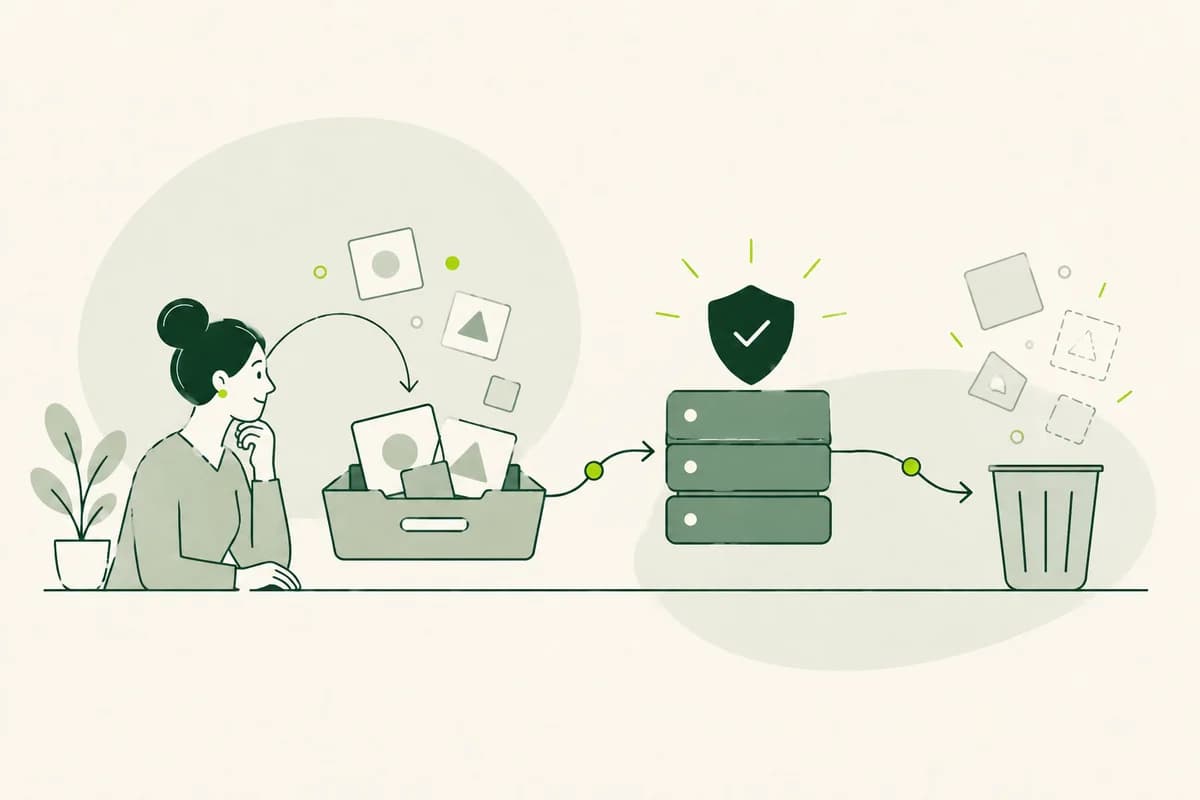
A single file can exist in multiple locations
An editorial team deletes an uploaded contract draft from its workspace. While it disappears from the daily view, it may not vanish instantly from every technical copy. A search function might still have a cached entry, a backup run might contain the earlier version, and a security log might document the deletion process.
These copies serve different purposes. The workspace provides content, a cache speeds up access, a backup enables recovery after a system failure, and logs assist in incident investigations. Consequently, a simple statement like "We store data for 30 days" is insufficient; it leaves unclear exactly which data is being referred to and where it is located.
When making a purchasing decision, distinguishing between these aspects is more important than a brief marketing slogan. A provider should be able to describe when data leaves active use, when caches are refreshed, and how old backups are phased out. Derived files and contracted service providers are also part of the picture. Only then can you gain a realistic understanding of how long information might remain available, recoverable, or technically present in the system.
Retention begins with a specific purpose
Data is not usefully retained simply because storage space is cheap. An organization needs a justifiable reason. A published article remains available as long as it is part of the service offering. Billing data may be required for longer periods due to legal obligations. In contrast, an unprocessed test import usually has no lasting value and should not sit in the production account for years.
The purpose also determines which components are required. For billing purposes, an amount linked to a contract might be necessary, whereas the full content of a translated document is not needed. Differentiated retention policies prevent the need to keep all information for the same duration. At the same time, they facilitate information requests, exports, and eventual deletion because the datasets are more clearly defined.
A retention period requires a clear starting point. "90 days" can be calculated from the time of upload, last edit, contract termination, or deletion request. These distinctions are significant for buyers. The triggering event must mean the same thing in both the product and the contract. A file stored for the duration of a five-year contract plus an additional 90 days has a different lifecycle than a draft that automatically disappears 90 days after its last use.
A cache is a temporary working copy
A cache keeps frequently accessed data closer to the users. This allows a website to load faster and ensures a service does not have to regenerate the same content with every request. The copy is not intended as a permanent archive. It should expire after a limited time or be specifically refreshed when the underlying content changes.
After a correction is made, old text may still remain visible briefly if the cache has not yet been updated. If a cover image has been replaced, this is usually frustrating. A change to an emergency call number or the deletion of personal data can be a critical matter. Providers should therefore explain how quickly urgent changes reach all delivery points and whether immediate removal is possible.
Caches can exist in the browser, in the content delivery network, and within an application. Deletion in the primary system does not automatically clear these layers at the same moment. A robust product design identifies the relevant storage locations and links them to the deletion process. The behavior of browser pages that are already open should also be taken into account. Buyers do not need a technical diagram for this, but they should be given a clear statement regarding the maximum delay involved.
Backups protect against data loss, not against decisions.
A backup preserves a previous state in case a system is damaged, data is accidentally deleted, or an attack alters the active environment. This safeguard is useful precisely because it does not immediately incorporate every change. If an accidental deletion were to instantly remove all backups, recovery would be virtually impossible.
However, this does not mean that backups must be kept indefinitely. A provider can create new backups daily and overwrite older ones after a set period. The retention period depends on recovery needs, risk factors, and legal requirements. It should be documented and must not simply grow unchecked because old storage media are never reviewed.
Furthermore, backups are not a secondary product archive. Employees should not routinely search them for old customer data or copy out individual files for new purposes. Access is restricted to recovery operations and strictly limited technical checks. Access is granted to only a few authorized individuals and is logged in a traceable manner. If a backup is restored, previously deleted data records must subsequently be removed again or otherwise excluded from active use.
Deletion involves several visible steps.
When a user deletes a document, it should first disappear from the user interface and from standard search results. Access via an old URL must no longer work. Background tasks, thumbnails, and derived text versions must adhere to the same status. Otherwise, content remains effectively available even though the interface has already confirmed successful deletion.
Some products initially offer a "Trash" or "Recycle Bin" feature. This brief recovery window can prevent accidental loss but must be clearly labeled. The user should know how long an item remains there and who can restore it. The status "Deleted" must not be displayed if, in reality, the item has merely been moved indefinitely to a hidden area.
Upon final deletion, the data record disappears from active systems. In rotating backups, an earlier copy may persist until the backup retention period expires, without being used for routine operations. The data subject receives clear and accurate information regarding this. This exception requires a specific retention period, access restrictions, and a procedure ensuring that the data is not permanently reinstated during a system restore.
A support case illustrates the entire data lifecycle.
A customer sends a screenshot containing a name and account number to support. The image initially resides in the ticketing system and possibly in an email inbox. If forwarded to a technical specialist, an additional copy may be created. While the screenshot helps resolve the issue, its full content may no longer be needed once the case is closed.
A clear rule distinguishes the ticket from its attachment. The concise case history may be retained for a limited time to handle follow-up questions, whereas the sensitive screenshot is removed sooner. Statistical data regarding the error type - stripped of names - may remain useful for a longer period. Thus, the retention period is determined by the remaining purpose rather than being based blanket-style on the largest data record.
If the customer subsequently closes their account, product data, pending exports, and support systems must be considered together. The provider should be able to explain which information disappears immediately, which is retained in a restricted state due to legal obligations, and when backup copies expire. Open support cases must not go unnoticed in a secondary channel. A clear, comprehensive answer traces the data’s lifecycle rather than focusing solely on the interface of a single product.
Buyers need specific statements rather than absolute ones.
The promise that "data is deleted immediately" sounds reassuring but is ambiguous without further explanation. Does it apply to the active dataset, all caches, search indices, logs, and backups? A credible answer specifies the various levels and their respective timeframes. It also explains whether deletion occurs automatically or must be initiated by a support team.
What happens at the end of the contract is also important. Some services allow customers a short window for data export before blocking access, while others remove active content immediately. Buyers should know when this period begins, how to request an earlier deletion date, and whether associated subcontractors carry out the same process within defined timeframes.
A provider need not promise to remove every technical copy with second-by-second precision. However, they should understand the actual process and describe it clearly. Vague phrases like "industry-standard duration" or "to the extent necessary" are insufficient for assessment purposes. A sample disclosure regarding a typical dataset can help illustrate the details. Concrete limits, documented exceptions, and identified responsible parties demonstrate that the commitment is embedded in actual operations.
Exports and logs require their own limits.
A data export creates a new file outside the standard working environment. It may be made available in a download area or sent via a link. Such files often contain a large amount of information and should automatically expire after a short period. The deletion process for the original account must not overlook any export that remains accessible.
Logs help detect errors and unauthorized access. This may require recording the user ID, timestamp, and action performed. The full content of a document generally does not belong in every log entry. If sensitive text is included in error messages, copies are created that are difficult to locate and may be subject to a much longer retention period than the data in the actual product.
Anonymized data also requires a precise description. If an individual can be re-identified using additional information, the data is not truly anonymous. Permanent statistical records should contain only those attributes necessary for their intended purpose and must not allow for re-identification. Rare combinations of attributes can make it particularly easy to link data back to a specific person. Pseudonymous identifiers reduce visibility but do not replace retention and deletion rules.
A restoration process must not bring back deleted data.
Following a major system failure, a provider restores a backup from the previous day. This backup contains data that customers have deleted in the interim. Without further precautions, this content would reappear in the active system. Therefore, the restoration process requires reconciliation with subsequent deletions and blocks before the product is fully put back into use.
This reconciliation can be performed using a separately secured log of deletion events. It contains only the necessary identifiers and timestamps, not the deleted content itself. After restoration, the system re-applies these deletion decisions. Retention periods that expired during the interim are also taken into account to ensure that the restored state does not become a permanent fixture.
Restoration procedures should be tested regularly. A backup that no one can successfully restore offers only a false sense of security. Testing must also demonstrate that access rights, deletions, and current settings are preserved. The results allow for corrections to be made before an actual emergency occurs. For buyers, this connection is crucial: protection against data loss and protection against the unwanted reappearance of data are part of the same reliable operation.
A good rule remains verifiable in day-to-day operations.
Retention periods belong in more than just a contract. The product must implement them technically, and responsible teams must be able to detect deviations. Regular checks can reveal whether old exports actually disappear, expired recycle bins are emptied, and backups are overwritten after the designated period. The results should be understandable to the relevant personnel.
If a purpose, legal obligation, or technical service changes, the rule is re-evaluated. A new search provider might generate additional copies, or a reduced need for support might render an existing retention period unnecessary. Changes are not merely decided on paper; they are tracked through to caches, subcontractors, and restoration workflows.
Trust is built through precise, specific statements. Active data remains available only as long as its purpose justifies it. Caches expire promptly, backups rotate securely, and deletions propagate across interconnected systems. Openly explaining these distinctions enables an informed purchasing decision and prevents misconceptions regarding a complex technical process.