
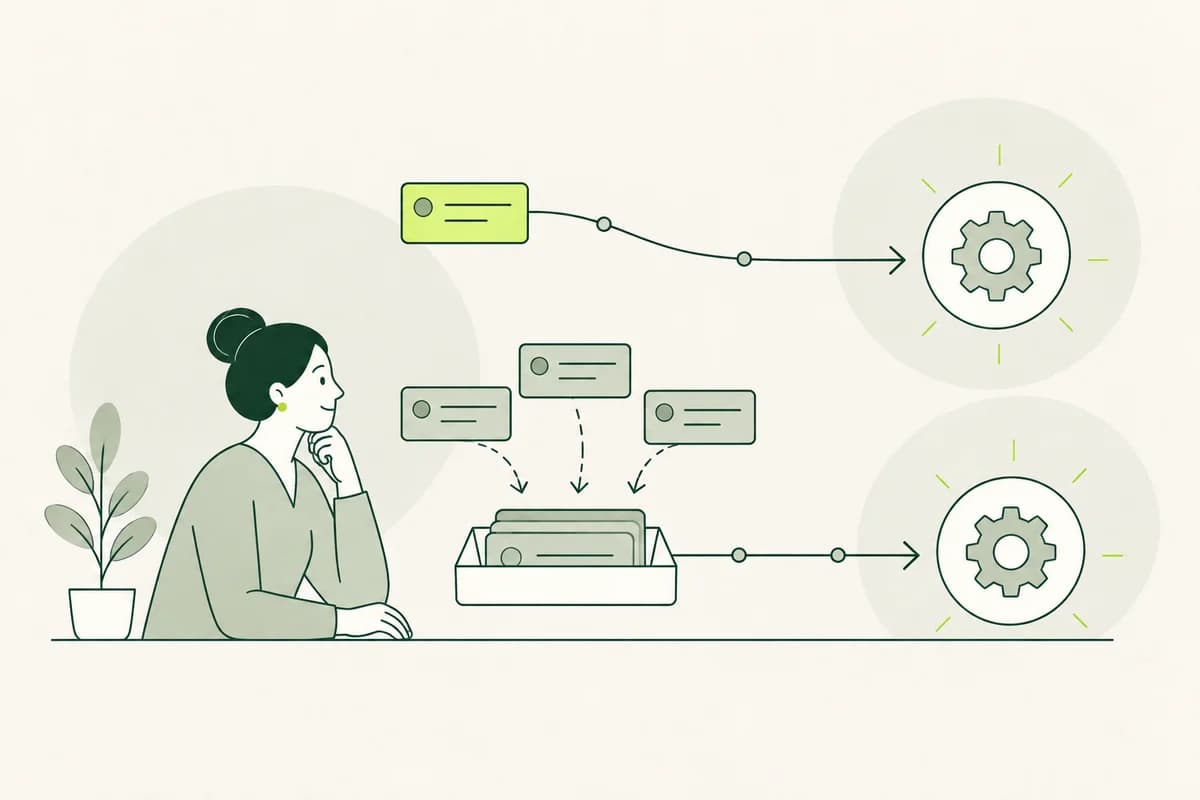
The key difference lies in the timing
An editorial team publishes an update to a counseling center listing at 10:14 AM. The website needs to display the new phone number immediately; the portal’s internal search engine needs to update its index; and a simplified language version requires expert review at a later stage. While these actions stem from the same change, they do not all need to be processed at the exact same moment.
A webhook is a message sent from one system to another immediately after an event occurs. For instance, the editorial system might signal: "This page has been published." The receiving system can then retrieve and process that specific content right away, without waiting for the next general system run or constantly polling for new changes.
In batch processing, multiple tasks are collected and executed together. For example, all pages modified during the day could be checked for a report every evening. Such a run does not happen instantly, but it is highly predictable. It can process large volumes of data sequentially and provide the results as a consolidated overview, following a process with a clear start and finish.
Webhooks are ideal for specific, important events
Webhooks make sense when a prompt response offers a tangible benefit. Once an alert is published, the app should receive the same up-to-date content. When a page is withdrawn, it should disappear from the internal search function. Each message is triggered by a specific action and relates to clearly identifiable content.
For the editorial team, this process feels immediate. They approve a post and, a short while later, see the new version on the connected channel. However, this speed must not be confused with guaranteed simultaneity. Network errors, maintenance, or a busy receiving system can delay processing. The system must be able to withstand such interruptions.
Not every saved change should trigger a webhook. An automatically saved draft is not yet relevant for public search. Meaningful events are based on visible significance: published, substantially updated, withdrawn, or deleted. This results in connected systems receiving fewer messages and allows them to handle important state changes more clearly. Internal typo corrections can be handled differently from new facts, if necessary.
Batch processing suits large volumes and fixed schedules.
A large-scale run is suitable when a lot of content is processed according to the same rules. An organization might want to check all published pages every night for missing review dates. Whether the result is available at 2:00 AM or 2:20 AM makes little difference to readers. An immediate notification after every minor edit would be unnecessarily resource-intensive for this purpose.
A complete rebuild can also be carried out as a deliberate, consolidated process. After a change to the search system, 80,000 pages might need to be re-indexed. Individual webhooks would not reliably describe the dataset because unchanged content is also affected. A batch run starts with a known set of items and documents which pages were successfully processed.
A fixed schedule makes load planning easier. Image descriptions, translation drafts, or extensive quality checks require computing time and external services. A nightly run can contain this workload without slowing down publishing within the editorial system. This makes the duration more predictable for operations teams and service providers. However, urgent content still requires a faster path if a long wait would result in incorrect information.
The permissible delay is the primary factor.
The most important question is: How long can the connected system display an outdated version? In the case of a severe weather warning, minutes can be critical. For a monthly text quality assessment, a one-day turnaround is usually unproblematic. A clear timeframe is more helpful than a general requirement that every process be completed as quickly as possible.
The scope of a typical change is another factor. If a single page is usually published, a webhook can specify that exact page. If entire datasets change regularly, a scheduled run is easier to manage. Importing 4,000 new locations should not trigger 4,000 simultaneous follow-up tasks in an uncontrolled manner.
The consequences of a system failure are also part of the decision-making process. If a message is lost, an outdated phone number might remain in the app. If a nightly report fails to run, the editorial team can restart it in the morning. The tolerable delay should be explicitly agreed upon for each connected channel. The greater the immediate impact of a failure, the more important rapid retries, visible warnings, and an additional reconciliation of the complete dataset become.
A webhook message remains compact and unambiguous.
A well-structured message states what happened, the content involved, and when the event occurred. It also includes a unique event ID and the message format version. The receiving system can subsequently retrieve the full, up-to-date data via a secure interface. This keeps the message concise and avoids unnecessarily including the entire article.
This approach also prevents a delayed message from distributing outdated text. Suppose an editorial team corrects the same phone number twice in quick succession. Due to a disruption, the first message arrives later than the second. When the receiving system fetches the current status, it still receives the most recently approved version rather than the content of the delayed message.
Personal or confidential information should not be included in the message unless necessary. Logs, error reports, and administrative interfaces often store webhook data for extended periods. In many cases, a content identifier and the event type suffice. The authorized receiving system fetches further details only when it actually needs to process them. This ensures that technical error reports remain free of unnecessary business-specific content.
Message retries are a standard occurrence.
If the receiving system does not acknowledge receipt of a message, the sending system transmits it again. The first message might have already been processed, but its acknowledgment was lost. Therefore, the receiving system must be able to accept the same event multiple times without publishing a post twice or ordering the same translation twice.
The unique event number helps with this. If this number has already been successfully processed, the system can acknowledge the repeat and skip it. This is more reliable than comparing timestamps or titles. Two different changes can occur almost simultaneously, and a title can change even though the content remains the same.
The sequence of events is not always guaranteed either. A notification regarding publication might arrive after a notification regarding a subsequent correction. Version numbers or fetching the current content prevents an older state from taking precedence. For editorial teams, this means the visible state must be correct, even if technical messages follow an erratic path. Therefore, the receipt date alone must not determine which version is valid.
The recipient must verify the origin
In principle, a publicly accessible webhook address can be targeted by unauthorized parties. Consequently, the receiving system must not trust a message simply because it arrives at the expected endpoint. A common practice is to use a digital signature calculated from the content and a shared secret key. The recipient recalculates the signature and compares the two values.
Transmission takes place via HTTPS to protect content and access credentials in transit. The secret key should not be included in source code, public documentation, or the message body itself. It must be stored securely, made accessible only to necessary services, and rotated regularly. Old keys must be invalidated following a controlled transition.
A timestamp further limits the window during which a correctly signed message is accepted. This prevents a recorded request from being replayed arbitrarily later. Error responses should not reveal internal details to attackers. Nevertheless, sufficient information remains available for the internal team to specifically investigate rejected signatures or outdated message formats. Suspicious access attempts are rate-limited and logged in a traceable manner for security audits, subject to appropriate and clearly documented retention periods.
A large-scale process requires a traceable state
With 20,000 pages, a batch process rarely succeeds or fails completely. Some content may contain invalid data, while the rest is processed correctly. The process should therefore record, for each entry, what succeeded and what requires a retry. A single erroneous page must not block all subsequent pages.
Limitations imposed by external services must be taken into account. An interface might, for instance, permit only a specific number of requests per minute. The process then divides the workload into manageable batches and resumes after a pause. It saves its progress so that a restart does not begin again at the first page, unnecessarily repeating work that has already been paid for.
For the editorial team, a comprehensible result is more important than a lengthy technical log file. They need to identify which run is affected, how much content is complete, and which pages require expert attention. A notification simply stating "37 errors" is insufficient. Linking errors to page titles, addresses, and specific causes transforms them into actionable tasks. Once successfully reprocessed, these items disappear from the active editorial view.
A scheduled run often complements webhooks.
Webhooks and batch processing are not mutually exclusive. A news portal can instantly notify its search function of new articles while reconciling its entire inventory overnight. The rapid method keeps critical changes up to date, while the scheduled run catches events missed due to disruptions, incorrect settings, or temporarily unavailable endpoints.
A localized version may also require both approaches. When a specialized page is modified, the webhook immediately generates a task for the responsible editorial team; the verified version is not automatically replaced. Additionally, a daily report lists all open tasks, deadlines, and content items where the link to the source page is missing.
A clear source for the authoritative state is crucial. A webhook signals a change, while regular reconciliation confirms the current inventory. If the two provide conflicting data, the most recently executed process must not simply win by default. The publishing system remains the definitive source, and connected systems align their state with it. This rule must remain clearly documented, even after a system migration.
Operations must remain understandable to humans.
Technical reliability is reflected in the information visible to users. Teams should know the typical duration of a transfer and at what point a delay triggers an alert. A warning should specify the affected channel and content, rather than just citing an internal process name. This allows the editorial team to determine whether visitors are currently viewing outdated information.
Every process requires a designated responsible party. This party can resend a stalled message, resume a batch run, or halt an incorrect publication. At the same time, it must be clear when subject-matter expertise is required. A technical team can transfer a file, but cannot decide whether a modified eligibility criterion has been explained correctly in terms of content.
The appropriate solution is thus determined by the content, timing, and potential impact. Webhooks respond quickly to individual events. Batch processes handle scheduled volumes and synchronize inventory data. Together, they ensure that both real-time updates and inventory completeness are addressed. By incorporating retry mechanisms, security measures, and clear notifications from the outset, connected websites and services remain up to date without burdening daily editorial workflows with unnecessary technical complexity.